It’s 11:47 on a Tuesday morning on the assembly floor of an automobile plant on the outskirts of New Delhi. A welding robot on Line 3 has thrown a fault — red light, arm frozen mid-cycle. Anwar, the maintenance supervisor, is wearing gloves and safety glasses, standing two meters from a 200-tonne stamping press. He can’t type. He has thirty seconds before the line stops.
He hits one button on a panel and speaks Hinglish:
“Welding robot pe lal batti jal rahi hai, arm beech mein hi ruk gaya hai, spot weld miss ho raha hai shayad. Yeh urgent hai, line ruk gayi hai.”
A voice agent answers in Hindi in about 1.1 seconds. Fast enough that Anwar stays on rhythm and the conversation feels real. (Humans notice pauses starting around 250-300 ms; under 1.5 s end-to-end is the threshold where voice conversations feel natural rather than transactional.) The agent asks the machine code, confirms the severity, files a work order, and notifies the maintenance head over WhatsApp. The whole exchange takes 47 seconds.
This isn’t a demo. It’s the kind of voice agent we run in production today. It’s also the kind of system that, if you actually try to build it, forces you into a four-way tradeoff nobody in voice AI marketing is honest about.
This post is about that tradeoff.
The thesis
A production voice agent lives at the intersection of four constraints:
- Cost. What one minute of conversation actually costs you, at scale.
- Latency. End-of-speech to first-audio-out. The only latency number that matters.
- Intelligence. Does the model understand the operator’s intent and produce a useful response.
- Language. Does it work in the language your users actually speak, including code-switching.
You can’t maximize all four. Most voice-agent decisions are really decisions about which axis you can’t compromise on. Pick wrong and you ship something technically impressive and operationally useless.
We’ll work through this in two passes. The first is for ML and backend engineers: how the pipeline fits together, where the milliseconds and dollars go, what we’ve measured. The second is for CTOs and engineering leaders: what this costs at 8,000 voice-minutes per month, where the procurement decisions live, and what to ask vendors.
Every number is cited. Where a number is vendor-self-reported, we say so. Where it’s measured, we say so.
1. The pipeline, end-to-end
“Voice agent” describes two completely different things. Worth getting that straight before we go further.
Cascade. Three specialized models stitched together. STT transcribes the audio. An LLM decides what to say. TTS renders the reply as audio. Three vendors, three handoffs, three places for things to break. Most engineering effort goes into the seams.
End-to-end. One audio-native LLM. Audio in, audio out. No intermediate text. Gemini Live and OpenAI’s Realtime models are the canonical examples. Fewer hops, lower latency, different cost curve, weaker language coverage.
Cascade is where production stacks live today. End-to-end is catching up on quality, but it still costs more per minute and loses badly on Indian languages, especially when speakers code-switch mid-sentence.
Where the latency actually goes
Our production cascade: Sarvam Saaras streaming STT, Gemini Flash, Sarvam Bulbul streaming TTS. Here’s the budget.
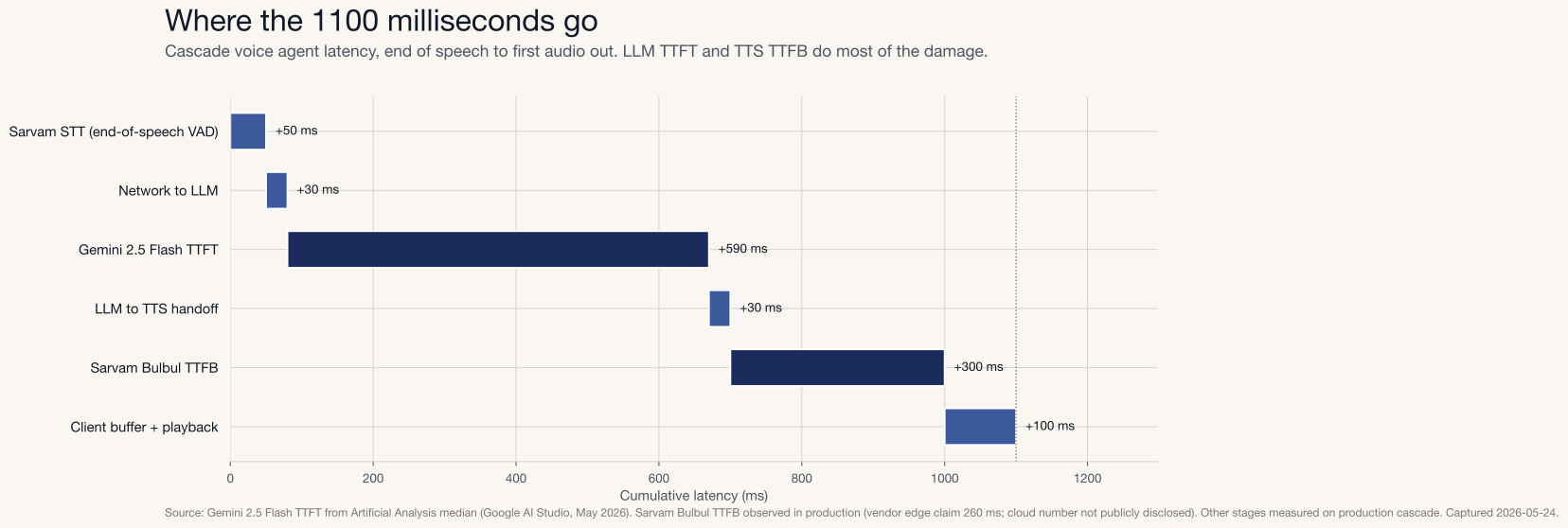
Two stages dominate. Gemini Flash TTFT is around 590 ms (Artificial Analysis median). Sarvam Bulbul TTFB is around 300 ms. Everything else is noise. If you’re optimizing latency without touching those two, you’re not optimizing anything.
The Gemini number isn’t ours; it’s the published median. We re-ran
our own benchmark to sanity-check it: 32 calls of the same 1,500-token
Hinglish system prompt against a comparable hosted model. Numbers lined
up. Raw data sits in benchmark/results/warm_turn_*.json if
you want to verify.
One thing most teams get wrong: they obsess over STT. Modern streaming STT adds maybe 50 ms after end-of-speech. That’s not the problem. The model generating the response and the audio synthesizing it are the problem. In that order.
2. STT, where the language axis hits first
STT is where the language decision either solves itself or owns you.
English is solved. The STT market for English-only voice agents is now a commodity. Whisper large-v3 hits ~2% WER on LibriSpeech test-clean and ~5% on Common Voice 15. Parakeet RNNT runs faster than real time on a single A10. Deepgram Nova-3 streams with ~150 ms TTFT (Deepgram’s own benchmark says 5.26% WER on real-world audio; Artificial Analysis says 12.8% on the same model, which tells you everything about vendor vs independent numbers). AssemblyAI Universal-3 Pro Streaming hits ~1.56% WER at $0.0075/min. You can ship a production English voice agent with $0/min STT cost on self-hosted Parakeet or Whisper.cpp and nobody will notice.
Indian languages are not solved. If your users speak Hindi, Tamil, Telugu, Bengali, Marathi, Kannada, Malayalam, Gujarati, Punjabi, Odia, or any of the other 22 official Indian languages, and especially if they code-switch (Hinglish, Tanglish, Tenglish; every real Indian conversation does this), the picture changes completely.
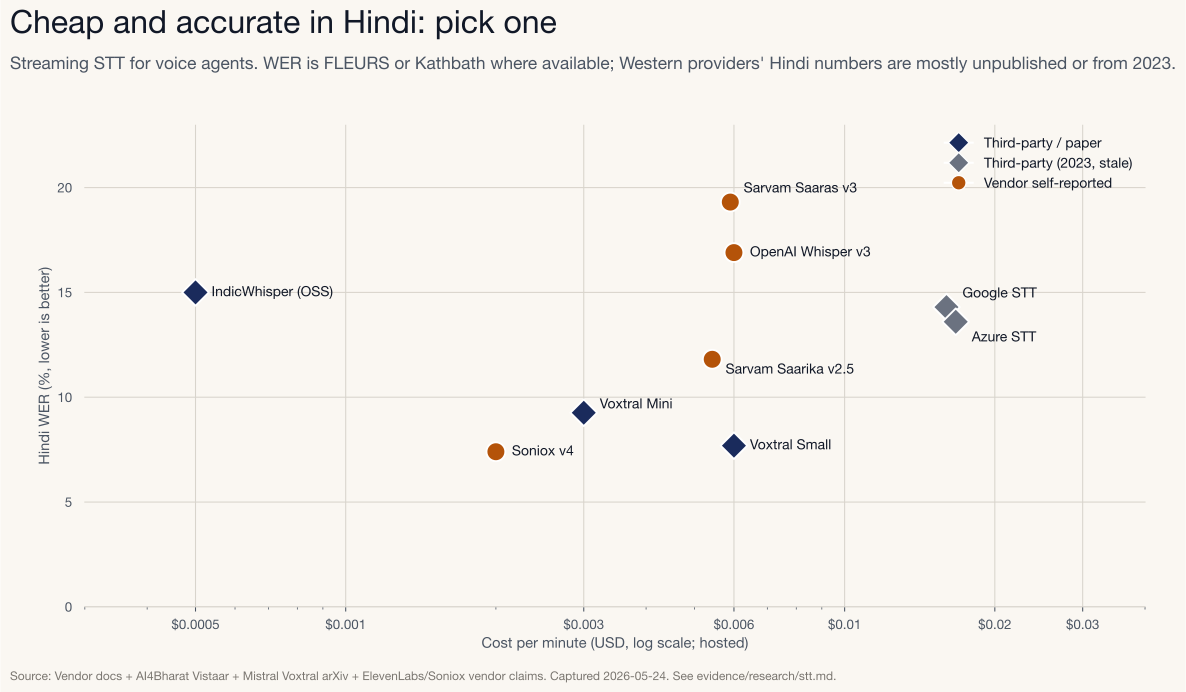
A few honest observations from this chart:
NVIDIA Parakeet TDT v3, the latest and fastest variant on the Hugging Face Open ASR Leaderboard, does not support Hindi. The TDT v3 release covers 25 European languages. Hindi, Chinese, Japanese, Korean, and Arabic are all absent. NVIDIA’s older Parakeet RNNT 1.1B multilingual variant does cover Hindi (
hi-IN), but it’s the slower architecture, not the headline TDT generation. The flagship OSS ASR frontier is openly skipping Indic languages. (Parakeet TDT 0.6B v3 model card and RNNT 1.1B multilingual, captured 2026-05-24.)The Indian providers occupy the price-quality frontier for Indian languages. Sarvam Saaras v3 covers all 22 official Indian languages plus English at $0.0059/min (₹30/hour) and posts 19.31% WER on the IndicVoices benchmark across the top 10 languages. Reverie offers quote-based pricing. Soniox sits at $0.002/min with 7.4% Hindi WER on their own benchmark. Western providers (Google STT, Azure STT) sit at $0.016/min with 13-14% WER on the 2023 AI4Bharat Vistaar benchmark (the most recent third-party multi-vendor data available), and their coverage of Tamil, Telugu, Bengali, Marathi, Kannada, Malayalam, and Gujarati ranges from “supported but underbenchmarked” to “missing entirely.” (Sarvam Saaras blog, AI4Bharat Vistaar, both captured 2026-05-24.)
Real-world Indic WER is much worse than benchmark numbers. AI4Bharat reports Hindi WER blowing up to 22-30% on telephony audio; the gap is similar or worse for Tamil, Bengali, Marathi, and lower-resourced languages where training data is sparser. Sarvam’s IndicVoices number (~19% on Saaras v3) is closer to shop-floor reality than the clean-audio numbers any vendor publishes. Budget for that. (AI4Bharat IndicVoices study.)
So which STT?
If your voice agent is English-only: - Cheapest: Groq Whisper Large v3 Turbo at $0.04/hour ≈ $0.00067/min. (Groq pricing, 2026-05-24.) - Lowest TTFT: Deepgram Nova-3 at ~150 ms US-region. AssemblyAI Universal-3 Pro Streaming at ~1.56% English WER and $0.0075/min. - OSS path: Faster-Whisper large-v3 on your own GPUs.
If your voice agent must handle Indian languages (Hindi, Tamil, Telugu, Bengali, Marathi, Kannada, Malayalam, Gujarati, Punjabi, Odia, or any other Indic language, including the code-mixed dialects): - Production default: Sarvam Saaras v3 at $0.0059/min. All 22 official Indian languages plus English, native code-mix handling, sub-150 ms TTFT in fast mode. Sarvam has explicitly tuned Bulbul (their TTS) for 8 kHz telephony bandwidth, which is exactly the channel a phone-based manufacturing voice agent runs on. - Strong open-source alternative: AI4Bharat IndicConformer-600M-Multi. Covers all 22 Indian languages, MIT-licensed, RNNT streaming under 100 ms latency on self-hosted GPU. The only OSS Indic ASR that meaningfully challenges Sarvam on language breadth. - OSS path with effort: Mistral Voxtral Small. Apache-licensed, 7.69% FLEURS Hindi, but no native streaming infrastructure yet. Needs production wrapping. - Don’t bother with: Parakeet TDT (no Indic), Deepgram Aura-2 (no Indic, that’s TTS but worth flagging), AssemblyAI for languages beyond Hindi (limited coverage in Tamil/Telugu/Bengali).
The provider coverage matrix
When a CTO asks “can we support all our regions with one provider?”, the answer is almost never yes:
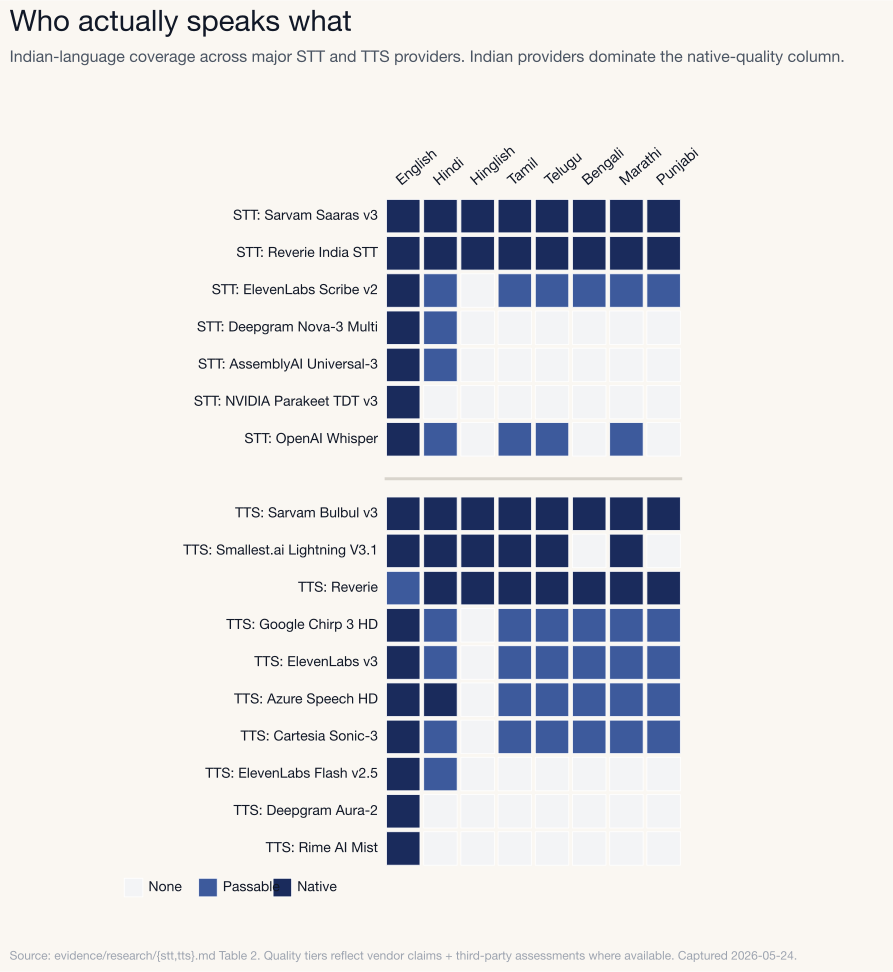
Sarvam and Reverie span all 22 Indian languages. Smallest.ai covers 7 of them: Hindi, Tamil, Telugu, Kannada, Malayalam, Marathi, Gujarati. Notably no Bengali or Punjabi. Western providers cover English natively, Hindi passably, and most are simply absent for Tamil, Telugu, Bengali, Marathi, Kannada, Malayalam, Gujarati, Punjabi, and Odia. If your operators or customers speak more than one Indian language, you’re picking Sarvam, Reverie, or AI4Bharat (OSS). Full stop.