5. The four-axis tradeoff visualized
All of the above collapses into one picture.
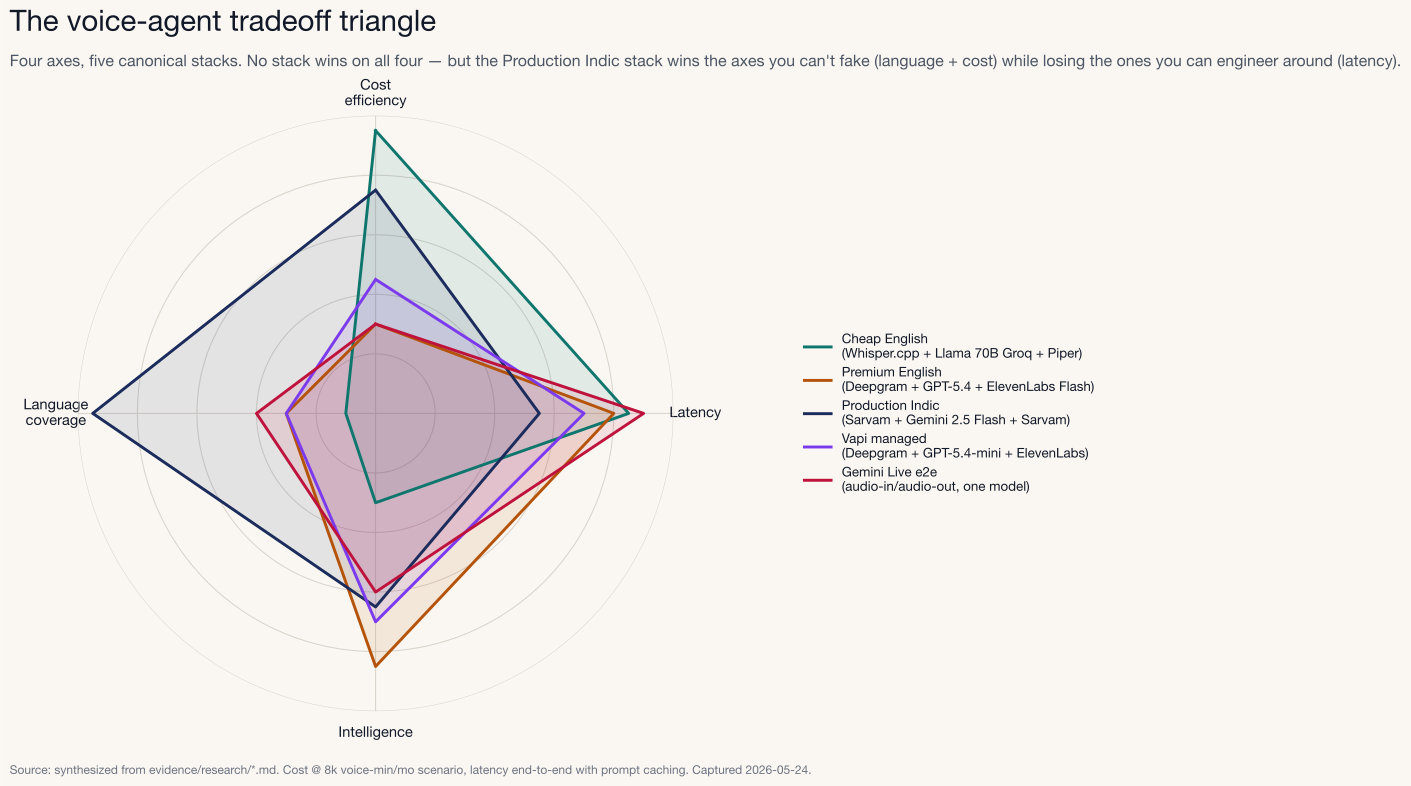
Axes normalized 0 to 1, higher is better. Cost efficiency means cheaper. Latency means lower end-to-end ms. Intelligence is AA Index plus Hindi capability blended. Language coverage runs from English-only to multi-Indic.
No stack wins on all four. That’s the entire point.
- Cheap English (Whisper.cpp + Llama 3.3 70B on Groq + Piper). Maximum on cost, near-maximum on latency, mediocre on intelligence (Llama 14 AA Index), low on language. Use when you have a budget constraint and an English-only user base.
- Premium English (Deepgram + GPT-5.4 + ElevenLabs Flash). Wins on intelligence, second on latency, expensive, English-first. Use when the language constraint is solved and you can pay for quality.
- Production Indic (Sarvam Saaras + Gemini 2.5 Flash + Sarvam Bulbul). Maximum on language. All 22 Indian languages plus English, with native code-mix handling. Second on cost. Middling on latency (India-to-US network round trips dominate). This is what we run.
- Vapi managed. Middle of every axis. You are paying ~$0.05/min for orchestration, retries, telephony, observability.
- Gemini Live e2e. Highest latency score (one round trip), low cost, English-leaning, lower intelligence ceiling than the best cascade options. The “audio-native” play.
The framework is simple. Find the axis you can’t bend. Optimize the other three around it. A manufacturing CMMS for Indian operators can’t bend Language. A US telesales pilot can’t bend Latency. A 12-market consumer app can’t bend Cost. Everyone else has more flexibility than they think.
6. What this actually costs at 8,000 voice-min/mo
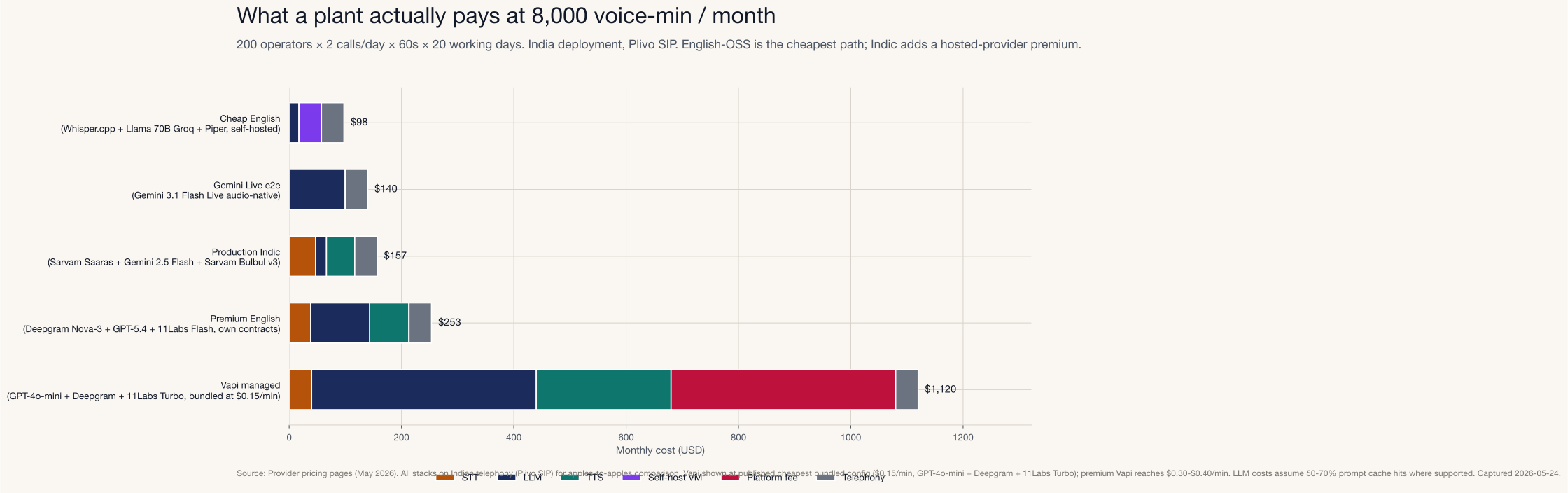
The scenario every CTO actually wants modeled: 200 maintenance operators, 2 calls per shift, 60 seconds per call, 20 working days per month. ~8,000 voice-minutes/month.
A few procurement-grade observations:
Cheap English on OSS is the cheapest production stack at ~$98/mo. A fully self-hosted Whisper.cpp + Piper TTS pair on a $40/mo VPS, with Llama 3.3 70B on Groq for the LLM, hits the floor of what a production English voice agent costs in 2026. The tradeoffs are real: Llama 3.3 70B’s intelligence is AA Index 14 (versus Gemini Flash’s 35), STT latency on a CPU VPS is higher than hosted alternatives, and you take on operational responsibility for the OSS infrastructure. But the bill is small.
Production Indic is $157/mo, about $60/mo more than English-OSS. That $60 gap is the Indic language premium. No production-grade OSS STT or TTS exists for Indian languages yet, so you pay Sarvam for hosted Saaras (STT) and Bulbul (TTS). Per-minute all-in is about $0.020. Still less than a single SaaS seat for a 200-operator plant.
Gemini Live e2e lands at $140/mo for English-leaning use cases. Audio-native LLM pricing is now genuinely competitive, between Cheap English ($98) and Production Indic ($157). The deciding factor is language coverage and intelligence ceiling, not cost.
Premium English at $253/mo is what you pay if you want paid Deepgram + GPT-5.4 + ElevenLabs. Roughly 2.5× more than OSS English for incrementally better quality and zero infrastructure work.
Vapi managed is by far the most expensive at ~$1,120/mo, and that’s the cheapest Vapi configuration. Vapi’s published cheapest stack (GPT-4o-mini + Deepgram + 11Labs Turbo at ~$0.15/min) lands at $1,120/mo at our 8k voice-min scenario. Premium Vapi configs (GPT-4o + 11Labs Multilingual) reach $0.30-$0.40/min, or $2,400-$3,200/mo. Vapi’s $0.05/min platform fee is only about a third of the cheapest-config bill; the rest is Vapi’s marked-up bundled provider rates. Vapi makes sense when you need telephony, retries, observability, multi-call routing, and your engineering team would burn more than $1,000/mo of time implementing those primitives.
Indian-region voice platforms price differently. Bolna lists ~₹5.52/min (≈ $0.066/min) for their Indian voice-agent platform. Western per-minute pricing on Vapi/Retell maps to roughly $0.15-$0.30/min equivalent. The Indian platforms are 30-50% cheaper than Western equivalents at comparable feature scope, but the gap shrinks once you BYO providers on either side.
One more thing CTOs ask about: compliance
In India, voice agents touch four compliance surfaces every procurement review covers. DPDP (Digital Personal Data Protection Act, 2023) for any PII captured in transcripts. TRAI (telecom regulator); outbound calls need DLT registration for many use cases. RBI if your voice agent handles any financial intent, BFSI guidelines apply. And the new AI Act drafts under MeitY. Sarvam, Bolna, and Reverie all have India data residency. Vapi and Western platforms typically route through US datacenters, fine for most manufacturing use cases but worth confirming before signing a contract.
Where the money inside one call actually goes
Per-call breakdown for the Production Indic stack:
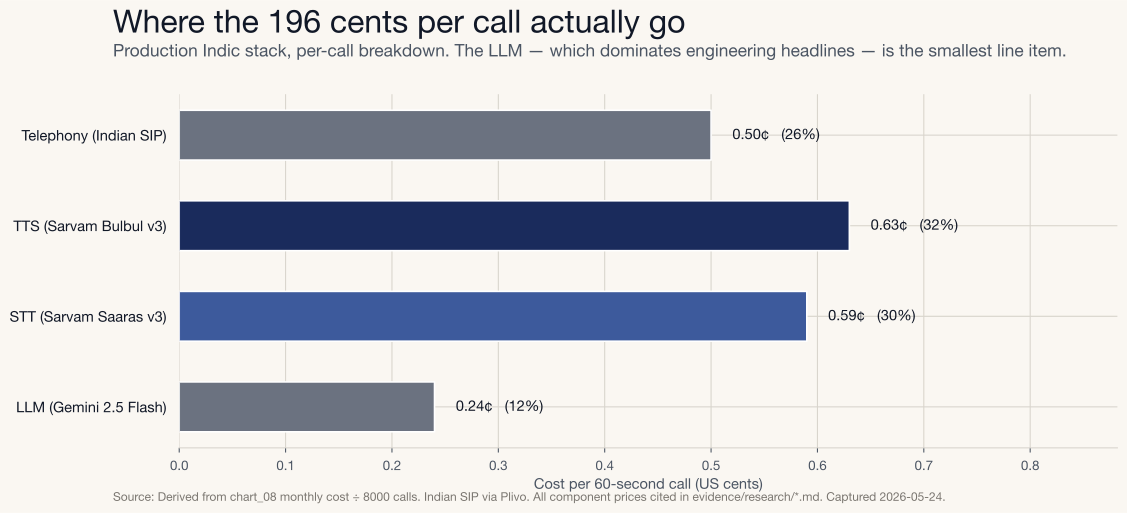
The LLM, which dominates engineering blog headlines, is the smallest line item on a Hinglish voice call. TTS is the biggest (Sarvam Bulbul billed per character), telephony is second, STT is third, LLM is fourth.
This breakdown changes everything about where to optimize. If a CTO asks “should we move from Gemini Flash to Haiku 4.5?”, the answer is “it won’t materially change your bill.” If they ask “should we cut the agent’s verbosity from 7 turns to 4?”, the answer is “yes, because TTS is your biggest line item.”
7. Latency optimization: what actually moves the needle
If your cascade is sitting above 2 seconds end-to-end, you’re almost certainly doing some combination of three things wrong: using HTTP request-response instead of persistent connections to your providers, generating the LLM response in full before starting TTS, or running services in a region distant from your providers’ endpoints. None of these are subtle. They’re the mistakes every voice-agent team makes on first deploy.
The general patterns that work, in descending order of impact:
- Stream every stage of the pipeline. STT should emit partial transcripts as audio arrives; LLM should stream tokens; TTS should synthesize on incoming chunks. If any one stage waits for the previous to complete, you’ve serialized the pipeline and given up the biggest single latency lever you have.
- Persistent connections to your providers. Per-turn HTTP handshakes (TLS, DNS, TCP) easily add 200-500 ms before any actual work happens. Most modern voice-AI providers expose WebSocket or HTTP/2 keepalive surfaces. Use them.
- Prompt caching. Voice-agent system prompts run 1,500–3,000 tokens (instructions + catalog + few-shot examples) and are constant across the call. Caching this prefix produces a step-change in TTFT, not just cost. Anthropic, Google Gemini, OpenAI, DeepSeek, and xAI all support some form (75-98% cost discount, similar-magnitude latency savings on a cache hit).
- Co-locate with your providers’ regions. Sarvam serves from ap-south-1. Google Gemini exposes ap-south-1 endpoints. Deepgram has multiple regional options. Running your voice orchestrator from us-east-1 against ap-south-1 providers costs ~200 ms of round-trip on every single API call.
- Tune VAD for your actual speakers. Default end-of-speech thresholds are conservative (300-500 ms of silence). Most voice agents work fine at 150-200 ms with care taken not to cut off slower or older speakers. The savings compound across every turn.
A useful rule for procurement: assume vendor TTFB is +50% from your region, and ask for end-to-end p95 numbers from a comparable production deployment, not lab-conditions p50.
8. Cost optimization: the engineering deep dive
Four levers, in descending impact order:
Use the smallest LLM that passes your eval. Voice agent tasks (slot-filling, asset code lookup, severity classification) are not where the bigger models earn their price. Build a 30-turn evaluation harness (Daily/Pipecat’s open-source aiewf-eval is a reasonable starting point) and run your top transcripts through Haiku 4.5, Gemini 2.5 Flash, Grok 4.1 Fast, and DeepSeek V4 Flash. Pick the cheapest one that gets 95%+ of the larger model’s output. Most teams settle on the 80%-quality bracket and that’s fine.
Truncate transcripts aggressively. A 7-turn call is ~4,000 tokens. A 20-turn call is 12,000. Voice context isn’t precious. Summarize old turns into 100 tokens of “what’s been said so far” after the 5th turn. Saves 30-50% on long-call cost.
Pick TTS by character price, not voice cloning fidelity. Per chart 6, $5/M Inworld Mini at Enterprise floor vs $100/M ElevenLabs Multilingual is a 20× spread for the same use case. Your operators will not notice the voice clone. The CFO will notice the bill.
Self-host the cheap stuff if you have GPUs idle. Piper TTS on a CPU is real-time. Whisper.cpp on consumer hardware is real-time. Kokoro 82M (open-weight, Apache-licensed) runs real-time on CPU too. If your STT + TTS is English-only and you have spare compute, you can take those line items to near-zero. The savings only matter at scale (above ~50k voice-min/mo), but at scale they compound fast.
The prompt-caching lever is covered separately in section 3. Worth treating it as a sixth axis of architecture decision, not just a cost optimization.
9. The honest conclusion
No best stack exists. There’s just the stack that matches what you can’t compromise on.
Can’t bend Cost? Self-host. Whisper.cpp, Llama 3.3 70B on Groq, Piper. Near-zero variable cost. You’ll pay for it in latency and intelligence.
Can’t bend Latency? Pay for an audio-native LLM. Deepgram, GPT-5.4, ElevenLabs Flash, all in the same region as your users. You’ll pay for it in cost.
Can’t bend Intelligence? Claude Sonnet 4.6 or GPT-5.4. Cache aggressively. Expect $300-500/mo at 8k voice-min. You’ll pay for it in cost.
Can’t bend Language? Use a stack built for the languages your users actually speak. For India that means Indic-tuned STT and TTS plus an LLM that handles code-switching cleanly. The round-trip to providers will push you above a second end-to-end. You’ll pay for it in latency.
The decision isn’t “which vendor wins.” The decision is “which axis am I optimizing.” Get that right first. Everything else follows.
ContextWeaver builds production voice agents for Indian manufacturing: work orders, preventive maintenance, voice intake, WhatsApp escalation. If you want a deep-engineering tour of a production voice agent in India, talk to us.